
When you lose a tooth, it affects not just the appearance but also the function of your smile. It can be difficult to eat or speak naturally. Extra stress is put on your remaining teeth, you’re at greater risk for developing gum disease, your remaining teeth can shift out of position, causing bite problems, and the shape of your face and jaw can change over time.
A bridge is a restoration that will help you maintain your oral health while making your smile complete again.
Bridges use prosthetic teeth to “bridge” the gaps caused by missing teeth. These false teeth are known as pontics, and are crafted from metal, porcelain, or porcelain fused to metal. Pontics can be matched in size, shape, and color to the teeth they are replacing for a natural appearance. A bridge can replace up to four teeth, but is typically used to replace one or two.
There are four common types of bridges, and the type of bridge that is best for you will depend on your preferences, your oral health, the location and number of missing teeth, cost, and other factors. Because a bridge requires healthy teeth, gums, and bones for long-lasting and successful restoration, any dental problems will need to be treated beforehand.
Traditional Bridge
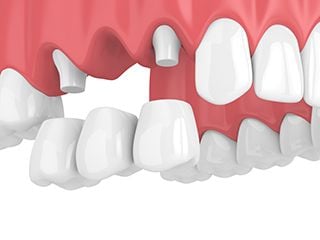 Traditional bridges are fixed in place and are anchored by crowns placed on the healthy teeth on each side of the gap. First, the two supporting teeth, known as abutment teeth, are prepared for crowns. This requires removing part of the tooth structure and creating an impression of each tooth. Crowns are created from these impressions and are attached to each side of the artificial tooth, creating the bridge. The crowns are then cemented to the prepared teeth, securing the entire bridge unit in place.
Cantilever Bridge
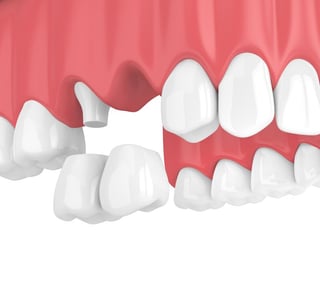 A cantilever bridge is used when there are no teeth available on both sides of the missing tooth to serve as abutment teeth. In this case, a healthy tooth on one side of the gap can be fitted with a crown to hold a single pontic. Because the pontic is only attached on one side, cantilever bridges aren’t recommended for the rear of the jaw, where chewing forces are much more powerful and the extra stress can damage the abutment tooth over time.
Maryland Bridge
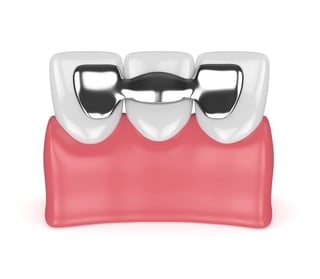
A Maryland bridge is a more conservative treatment than a traditional bridge because there is no need for crowns to hold the bridge in place. A pontic is created with two wings made of resin, porcelain, or metal attached to its back. These wings are then bonded to the backs of the two abutment teeth. This type of fixed bridge is often used to replace one or two front teeth; it’s not strong enough to replace molars. Because no crowns are necessary, a Maryland bridge is generally more cost-effective than other options.
Implant-Supported Bridge
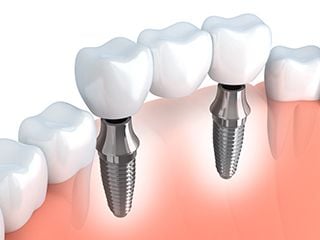 An implant-supported bridge is a bridge attached to dental implants. Posts are surgically implanted in the jawbone, and, over a period of months, fuse with the bone, providing an exceptionally strong foundation for a bridge. The number of implants needed will depend on the location of the bridge (upper or lower jaw), the number of pontics, and the quantity and density of the bone.
Once the implant posts have healed and are well-integrated into the jawbone, metal or ceramic abutments are secured to the posts. The bridge is then secured to these abutments. The bridge can be fixed or removable for easier cleaning.
While this type of bridge is often the most expensive option, implant-supported bridges help protect jawbone health. Without the stimulation of biting and chewing, the bone ridge under a missing tooth begins to lose density and shrink. Implants stimulate bone tissue just as natural teeth do to preserve bone strength and density.
You have many options for replacing a lost tooth. Your dentist can help you determine which type of bridge is best suited to restore your healthy, confident smile.